
Oh, the good ol’ American dream. Wouldn’t life be great with a home to call your own, a white picket fence, a couple kids, and a dog? It would be, but many Americans today can’t afford a home due to rising prices, stagnant wages, and high living expenses.
Oh, did I mention that a lot of Americans are also dealing with historically high levels of debt? With mounting student loans and credit card balances eating into our paychecks, buying even a tiny home at this point would feel like winning the lottery.
However, all hope is not lost. In fact, there is a really big opportunity here. Instead of worrying or wondering why you can’t afford a house, you can focus on something else. By focusing on this one thing, you will become wealthier in the long run than if you were to rush into purchasing a home.
What is it we’re talking about? Net Worth.

When You Can’t Afford A Home, Focus On Growing Your Net Worth
What is net worth? It’s the sum total of all your assets (money, cars, investment accounts, rare collectibles, etc.) minus any liabilities (outstanding debts, student loans, credit card interest, money owed to lenders, etc.).
Assets – Liabilities = Net Worth
In other words, it’s how much wealth you’ve accumulated.
The reason this is important is because when you start to get caught up in the FOMO of all your friends, family, and peers buying homes, your net worth is a reminder of where you truly stand financially.
You can be a multi-millionaire and still be living in an apartment or even your car! Do you think you’d really care about living in a car if you had 5 million dollars lying around in some investment accounts waiting for you to spend? Probably not. But I also don’t know why someone would be living in a car if they were that rich, but hey, I’m not going to judge.
See: If You Can Make $1, Here’s How To Make $1 Million
The key thing to understand here is that net worth is the true measure of financial success; not your income, not your fancy career, and not how much you think you’re going to make one day. Net worth is what you actually keep and grow over time.
The True Metric of Financial Success
So why is net worth the true measure of financial success? Why isn’t it income?
Income is so overblown. My whole life I felt like I was taught to think earning a high salary was the ticket to the good life. That I should be making $100,000/year or I’m just “not good.” I felt like I was walking around with my head hanging in shame and a scarlet number on my chest saying $60,000/year. *cries*
As I got older and learned about personal finance on my own, I realized that income was just a means to build my net worth. Net worth was the real sought after treasure.
A simple analogy:
- Income is the harvest you bring. Let’s say 10 corn stalks a day. (I know, kind of a weak harvest, but at least they’re taking some action.)
- Net worth would be the amount of corn stalks you have stockpiled away in your barn. Let’s say 500 kajillion infinity corn stalks!
Okay, that’s a lot of corn stalks. I don’t think we’re really going to care about our weak little harvests…
Cheesy example, but you get the idea. Income is not a true measure of wealth because you could have a stockpile of wealth that is far superior.
It doesn’t mean having a high income is worthless. The higher your income, the quicker you can build your stockpile, and the quicker you can reap the benefits of peace and security.
Net Worth Brings Peace and Security
We think the main benefit of a high net worth is so we can finally live on yachts and enjoy champagne showers. I’m getting seasick already imagining what that would be like.
No, the real benefit of a high net worth is physical and psychological peace, security, and well-being.
Do you know why that’s so valuable? When was the last time you weren’t worried about money? Probably never, unless you already have a high net worth and are living off investments, or you just won the lottery.
True security is a sense where you can finally just relax. You don’t even realize the underlying pressure of constant worry that’s always bubbling beneath the surface.
You’re always wondering: “Do I have enough money to pay my bills?”, “Can I afford to hangout with friends this week?”, “I have to buy Christmas presents for how many people this year!?” The list goes on and on.
What would it be like to silence that voice? What would it be like to be able to walk into a store, throw a bunch of items in a cart, and not even look at how much it all costs?
That would be financial heaven.
Alas, we are far too concerned about whether or not we can afford to buy a home. So let’s pause all this net worth talk for a second and let’s try to understand what all the hoopla is about home ownership.
The Deeper Reality Of Home Ownership
Why are we so obsessed with wanting a home? Is it the feeling of finally being an adult when we’re in a home? Is it so we can flex on our friends and family about the marble kitchen island in our new single-family? Or is it just because of all the media hype telling you that this is what you need to do?
It’s all of those things, but none of them at the same time. Let me explain.
The reason we want a home can be every single one of those situations, but that’s just what it appears like on the surface. The deeper reality is, we want a home because we feel we are lacking in something, and that new home is finally going to make that feeling go away.
A home is a material item like anything else. Have you ever gotten a new shirt that you were so scared to get dirty? 10 years later, where is that shirt now? It’s probably either donated or sitting in a bag with other old clothes in your garage. A house is the same thing. (And so is a car, a watch, a purse, a smartphone, and so forth.)
Even think about where you are currently living right now? Have you gotten over the allure and glamour of it yet? Has your living space just become another space you just exist in? That’s what will happen when you finally own a house too!
It’s not the things themselves that have value, it’s the way they make us feel, and those feelings are always fleeting.
One day we like something, the next day, month, or year we despise it. We could say to never believe our desires because they are always changing.
It’s best to see a home for what it truly is: a living space that you can customize if you have the money to, and that provides a place to sleep, eat, socialize, and relax.
It’s a glorified cave, lol.
It has value for those reasons, but every other meaning you assign to it has more to do with an internal position you may be holding about home ownership.
And what you may believe a home to be could be the opposite of what someone else believes it to be, and that’s why it’s all an illusion.
Okay, back to net worth…
The Net Worth Bar
Since net worth is not the mainstream way the average person judges their financial success, yet it’s more of an accurate measurement of it, I want to show you a visual that will help you determine where you are in your financial journey.
I call it The Net Worth Bar.
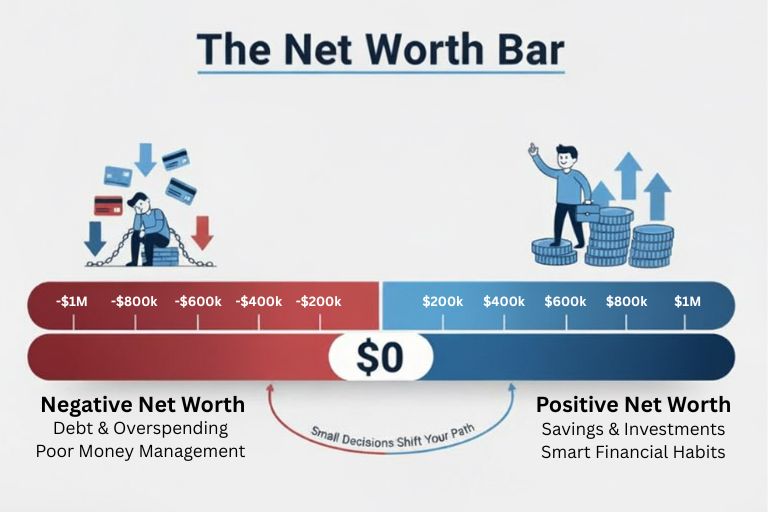
So you can see from this visual, if you move to the right, you’re doing well; if you move to the left, the harder life will get financially. Here are some possible scenarios on this bar:
- Positive Net Worth: $800k in investment accounts (asset) + $600k home value (asset) – $300k left on to pay on mortgage (liability) = $1.1 million net worth
- Negative Net Worth: $20k in savings (asset) + $10k car value (asset) − $60k student loans (liability) − $15k credit card debt (liability) = -$45k net worth
- Stagnant Net Worth: $50k in savings (asset) + $20k car value (asset) − $70k in student loans (liability) = $0 net worth
While positive and negative net worth are the two most common ways we think about net worth, the stagnant net worth can be a cause for alarm too.
A stagnant net worth may occur if someone reaches a point on the bar and stays there (or around there) into perpetuity. They may be 25 years old with a net worth of $25k, and by the time they are 65 and ready to retire, their net worth only grew to about $40k.
This individual spent a huge chunk of their life probably spending every paycheck and had no awareness of where they stood in their net worth.
A wise individual would be setting aside money every paycheck. Not just saving it, but investing it to have that money grow even more over time.
We want to stay on the positive side of this bar, but also be growing it, slowly and surely.
Get To Positive Cash Flow And Stay There
In order to stay on the positive side of cash flow and keep increasing it, we have to remind ourselves of the importance of cash management.
You don’t want to be like a leaf in the wind, getting pushed and pulled in the direction of life’s circumstances.
The key is to get to a positive net worth, have an income to move your net worth forward, and have automated systems in place like investments to keep it increasing automatically.
Try worrying about affording a home when every month you check your net worth and see it’s gone up $20k.
Set up your positive cash flow system, stay there, and keep finding ways to speed it up. Let the home come to you when God/Higher Power feels you’re ready to have one.
A Home Will Come In Time
If you can’t afford a home, just know that if you become net worth focused, it’s only a matter of time before you’re in a home.
In fact, those with a net worth focus will be able to actually “OWN” their home because they will have the ability to pay it off, instead of struggling with endless mortgage payments that sap your monthly income dry.
By eliminating all the monthly payments you have to make and having a high net worth that grows over time, you will slowly start to have the ability to buy whatever you want when you want. That is the ultimate financial peace.
We have to look at our life and financial goals in a broader context of our life and not just in a snapshot.
Those who focus on long-term wealth building will start to gain more confidence as their net worth starts to snowball. While those who spend freely daily, without the intention of growing their stockpile, never build anything permanent.
By planning for the future, you set yourself up to have a nice nest egg you can keep pulling cash from. But by neglecting the future for the sake of a better present, the future will still come, and when it does, you will have nothing.
So if you can’t afford a home right now, it’s not a matter of “if”, it’s a matter of “when.” Stay focused on the bigger picture, and everything will come to you in time.